

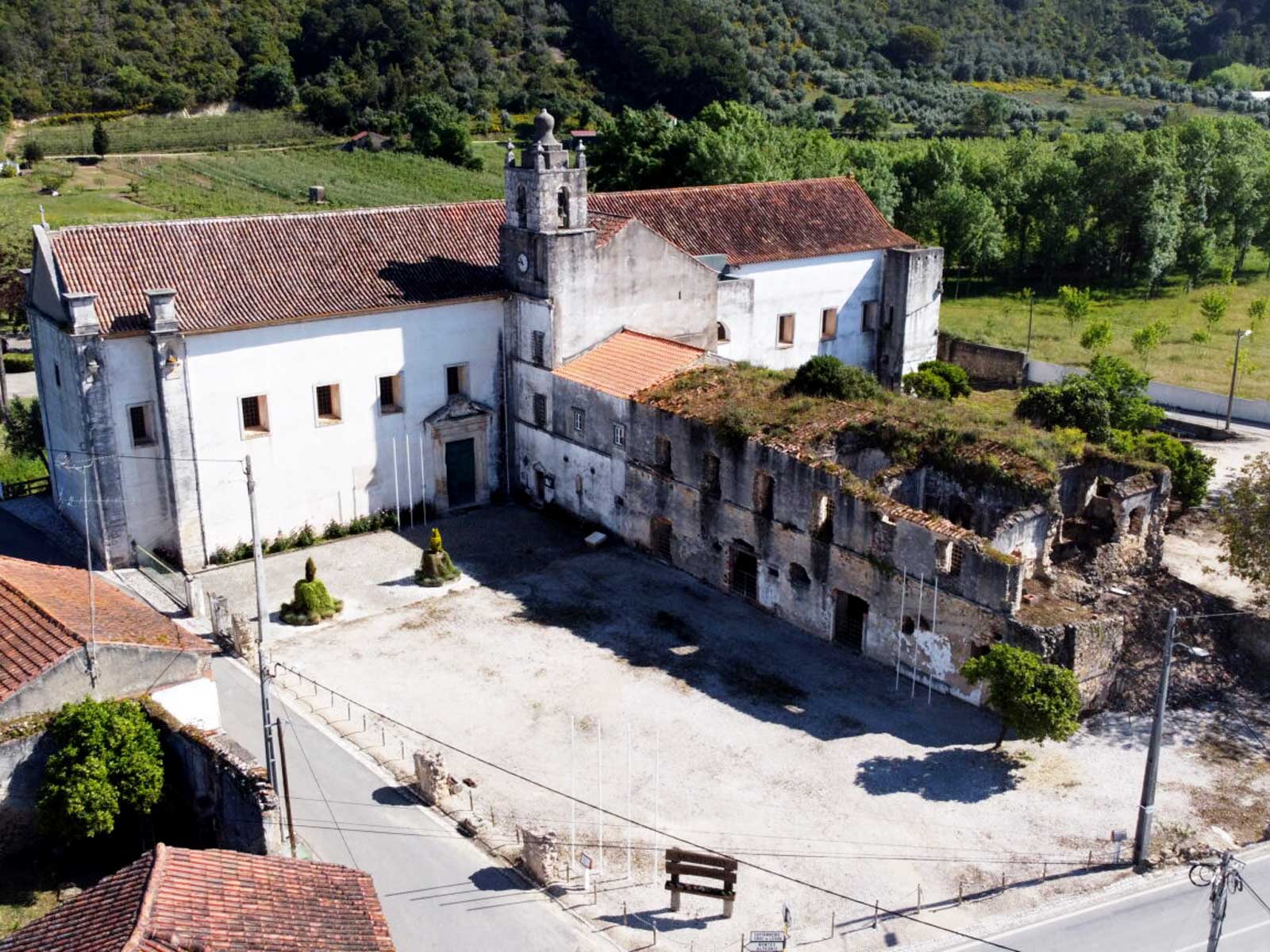
10 km from Alcobaça is Coz, one of the ancient settlements of the Coutos de Alcobaça, surrounded by fertile agricultural fields and ancient forests.
Visiting Alcobaça also means enjoying this magnificent architectural treasure, whose church has been classified as a Property of Public Interest since 1946. It is worth discovering a heritage framed in an immemorial atmosphere that survives in the bucolic nature of the surrounding countryside.
Here, in the 13th century, a community of Cistercian nuns took shape. Devout women who helped each other in the multiple tasks necessary for the good functioning of this Monastery. They would stay there until the extinction of the religious orders in the first half of the 19th century (1834).
In the 16th century, the Monastery of Santa Maria de Coz became one of the richest female monasteries of this order in Portugal. With its baroque artistic splendor, the church bears witness to the richness of this community.
The church has a very austere exterior architecture, with very sober lines. On the south side, the statues of São Bento and São Bernardo stand out.
Inside, the church and choir form a single body, 60 meters long and 21 meters wide. The ceiling is lined with impressive wooden coffers painted by Pedro Peixoto and dating from the early 18th century.
The naves are divided by an enclosing grid made of carved wood and painted in gold. On the side of the choir, the nuns’ chairs stand out, built between the end of the 17th century and the beginning of the 18th century, which, in its heyday, had 106 chairs, today it only has 92 seats. In the background, a beautiful Manueline portal.
The church is literally a baroque shrine. In it, the various altars of gilded carving of good execution stand out. Also noteworthy is the painting “O Purgatório” by Josefa de Óbidos (1630-1684). The tile coverings in the sacristy contain scenes from the life of Saint Bernard, the greatest promoter of the Cistercian Order.
Elements of interest:
-Gold carving of the church;
-Door Manueline;
-Chair of the nuns;
-Tiles coverings.
Source: Turismo do Município de Alcobaça
https://www.cm-alcobaca.pt/pt/2648/mosteiro-de-santa-maria-de-coz.aspx
Image source : https://ufcam.pt/mosteiro-de-santa-maria-de-coz-2/